Showing posts with label Porsche. Show all posts

2013 Porsche Cayman Spy Photos - Future Cars

No surprise here: The next Cayman looks a lot like the current one, and we’re okay with that.

. http://cdn.24.co.za/files/Cms/General/d/1385/e2815b7c1a4647c8bfb06300ffd1104b.jpg

Update: We now have much closer shots of the next Cayman, and they reveal a more 911-like silhouette and front end. The roof appears flatter than the current car’s, and we can see just how much the stretched wheelbase affects things like the size of the rear window. Less exciting: This prototype appears to have a sensor in the front fascia’s center opening, suggesting some kind of laser- or radar-based system like active cruise control will be offered.

http://www.roadandtrack.com/var/ezflow_site/storage_RT_NEW/storage/images/tests/draft-content/cayman-spy/gallery/photo_2/2513986-1-eng-US/w-porsche-cayman-priddy2_gallery_image_large.jpg
We’ve already spotted the 2012 Boxster in the wild—our editor-in-chief, Eddie Alterman, even snagged a few shots himself—but now we have the first spy photos of the next-gen Boxster’s hardtop sibling, the 2013 Cayman. Since the two cars share a platform, most of what we know about the Boxster will apply to the Cayman as well. This means carry-over flat-sixes, with a new flat-four as the base engine. The current Cayman engine lineup starts with a 265-hp, 2.9-liter flat-six, moving to a 320-hp, 3.4-liter flat-six in the Cayman S. We don’t know much about the new four-cylinder, but it most likely will be a shortened version of the six, rather than an all-new engine. Transmissions are not likely to change much, and the new Cayman should make do with the existing six-speed manual and seven-speed PDK dual-clutch automatic.
The upcoming Boxster will ride on a slightly longer wheelbase, and the Cayman will inherit the same extension. The longer wheelbase shows itself here in the Cayman’s longer rear-quarter windows and the longer roofline. Aside from an expected boost in interior space, perhaps the biggest benefit of the stretch is that the lengthened hatch affords a larger rear window.
Moving down from the roofline, the appearance of the next Cayman will change little from today’s car. The fenders are just as curved and pumped-out as the current Cayman’s, and the vertical intakes ahead of the rear wheels remain—how else are you going to feed a mid-mounted engine? While our shooter failed to snap any pictures of the front of the car, we got a clear look at the Boxster’s schnozz, and we can confidently say that not much will change up front for the coupe, either. (This is sort of a habit at Porsche; note how similar the next 911 will be to the current car—and the one before that, and the one before that, and so on.)
Then again, we can’t think of much we want to change. In an era of tremendous upheaval in the auto industry, Porsche’s mid-engine coupe is one thing we’re glad to see stay the same. Look for better, crisper pictures of the Cayman as its official debut sometime in mid-2012 draws near.
 Source: Carandriver.com

2011 Porsche Panamera 4S - CARS REVIEWS 2011

It’s what’s inside that counts most.

2011 Porsche Panamera 4S
What Is It?
Well, we’re still not sure. This all-wheel-drive S model is the fourth Panamera variant we’ve tested, and the hatchback-cum-sedan’s shape still hasn’t completely grown on us. It is agreed, however, that the Panamera is plenty agreeable to drive—and easier to enjoy from inside. Fortunately, that’s where they put the steering wheel and all of the important controls. Bless those Germans.
How Does It Drive?

The great thing about the Panamera is that you drive it, and not the other way around, as is the case with many big-buck sedans. There are no nanny systems to beep, blink, or otherwise distract, and, with the exception of launch control, there are no technoid aids. The launch control is the PDK transmission’s party trick—although other drivers may be too busy trying to figure out what the car is to challenge you to a race—and teams up here with all-wheel drive, a 400-hp V-8, and some fat Michelin Pilot Sport PS2 rubber to deliver a 4.2-second 0-to-60-mph time. That’s 0.5 second quicker than the rear-drive Panamera S. To put things in five-door perspective, the 4S trails our 556-hp Cadillac CTS-V wagon long-termer by just a tenth.
The Panamera’s steering is Porsche light, but offers the kind of feedback and accuracy that’s a boon on a back road and welcome on a highway cruise, where fewer corrections are better. The interior works well in both situations, too—it’s all-day comfortable, nicely detailed, and functional. Our favorite detail: the ultra-configurable color display that lives in the right-most gauge crescent. We set it up just right for a weekend trip, displaying speed-limit signs at the top and showing range, distance and time to destination, and audio info on the customizable “vehicle” screen. A nav display, trip computer, and phone menu are a flick away using the steering-wheel-mounted thumbwheel.
Over that 500-mile trip, we saw 24 mpg, meaning the car’s 26.4-gallon fuel tank can deliver a range of more than 600 miles. Our overall observed fuel economy was 20 mpg, smack dab in the middle of the EPA’s 16/24 city/highway ratings. Not bad, given the 4200-plus-pound curb weight and our heavy right feet.
How Does It Stack Up?
Despite having several near-competitors in its niche—which was essentially magicked out of thin air—the Panamera 4S may be most easily compared to its sister cars, which have recently expanded to include the S hybrid and Turbo S models. Comparables for the 4S from other makers include the cheaper and softer Audi A7, the harder-edged Mercedes-Benz CLS AMG, and the upcoming BMW 6-series Gran Coupé, which figures to lean more to the grand-touring side of the ledger. This Porsche offers a unique blend of agile, precise handling and comfort.
What’s the Cost?
As with any Porsche, this one’s up to you. The base price of $96,175 isn’t bad as full-bore Euro luxury sedans go (a rear-wheel-drive S can be had for about $5K less—bargain!). But you’ll surely want to spec the Sport Chrono Package Plus for $1480, because it adds the launch control. Then there was our test car’s extra leather for the seats and dash, which, while playing with funny money, we might as well get, too. We would, however, skip this car’s optional 20-inch wheels and their $3120 upcharge, as well as the colored-in center caps ($185). This example also had ventilated front seats for $800, a $1990 Bose audio upgrade, extra-cost paint ($790), and the $2350 Premium package, for a (hundred-)grand total of $110,545.
That’s undoubtedly a lot of money, but would you expect hyper-quick weirdness to be affordable?

Specifications

VEHICLE TYPE: front-engine, 4-wheel-drive, 4-passenger, 5-door hatchback

PRICE AS TESTED: $110,545 (base price: $96,175)

ENGINE TYPE: DOHC 32-valve V-8, aluminum block and heads, direct fuel injection

Displacement: 293 cu in, 4806 cc
Power (SAE net): 400 hp @ 6500 rpm
Torque (SAE net): 369 lb-ft @ 3500 rpm

TRANSMISSION: 7-speed dual-clutch automatic with manual shifting mode

DIMENSIONS:
Wheelbase: 114.9 in Length: 195.6 in
Width: 76.0 in Height: 55.8 in
Curb weight: 4247 lb

C/D TEST RESULTS:
Zero to 60 mph: 4.2 sec
Zero to 100 mph: 11.0 sec
Zero to 130 mph: 20.3 sec
Zero to 150 mph: 30.4 sec
Street start, 5–60 mph: 4.9 sec
Top gear, 30–50 mph: 2.8 sec
Top gear, 50–70 mph: 3.4 sec
Standing ¼-mile: 12.8 sec @ 108 mph
Top speed (drag limited): 175 mph
Braking, 70–0 mph: 159 ft
Roadholding, 300-ft-dia skidpad: 0.92 g
FUEL ECONOMY:
EPA city/highway driving: 16/24 mpg
C/D observed: 20 mpg
Source : Caranddriver.com

Diesel Porsche Panamera (2012)


Panamera range with the introduction of the new Porsche Panamera diesel, even more attractive model for UK customers. A luxury Gran Turismo, Porsche Panamera diesel is able to take four passengers in comfort sport Lands End to Loch Ness without refueling.

Dealing with effortless speed and ski mountaineering short, this is a long distance sports performance provided a smooth 3.0-liter V6 is rated 250 hp (184 kW) is achieved between 3800 rpm and 4400 rpm. Maximum torque is 550 Nm, available up to 1750 rpm 2750 rpm creates a great attraction. And 'only available in rear-wheel drive and uses eight high-efficiency ratios Tiptronic S transmission is standard. Six-cylinder turbo diesel engine powers the new Gran Turismo 0-62 mph (0-100 km / h) in 6.8 seconds and top speed is 150 mph (242 km / h).
Diesel Porsche Panamera offers a very attractive driving over 745 miles on a tank of 80 liters, emits 172 g / km and offers a combined consumption of 43.5mpg (6.5 litres/100km). With optional tires with low rolling resistance, improves efficiency even further, to 167 g / km and a combined cycle of 44.8mpg.

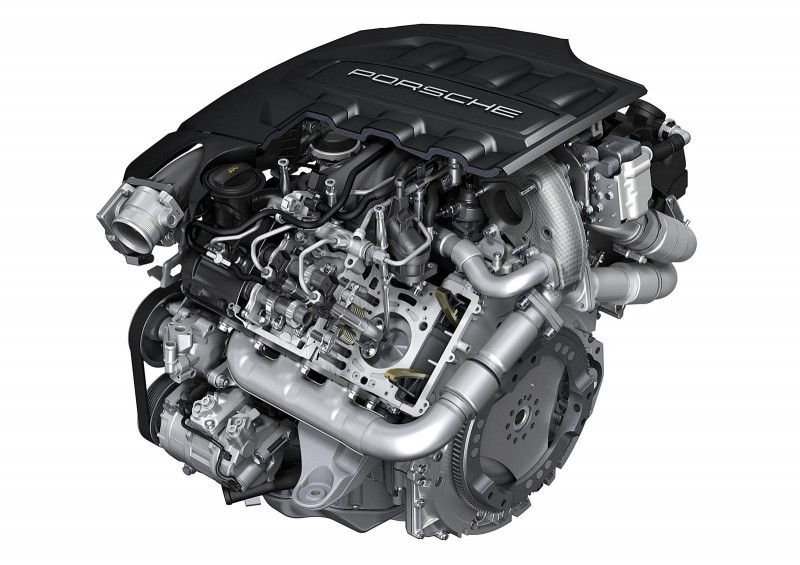
The engine of 3.0 liter V6 is the most advanced technology in diesel common rail direct injection via piezo valve at a pressure of 2,000 bars, variable geometry turbo with electric turbochargers (VGTs) and control emissions achieved by recirculation controlled exhaust gas oxidation catalyst and particulate filter.

Performance, generous torque and low consumption is accompanied by proper operation, reliability and low emissions. Another factor is the auto start / stop function, which is installed by default. Adaptive air suspension is available as an alternative to steel spring suspension standard, to give a wider range of suspension settings to extend the extra trip.
Through its proportions are only Panamera clear in its market segment: measuring 1931mm (76.0in) wide and 1418mm (55.8in) high, the Panamera is both wider and lower than comparable models with four doors. The unique, slender GT is created by a total length of 4970mm (195.7in) and short front and rear overhangs sports. This new model can be recognized by "diesel" letters on the front doors.

Each Panamera, the new diesel model has a high level of standard equipment that includes leather interior, Porsche Active Suspension Management (PASM), Bi-Xenon headlights Front and rear park assist, control tire pressure, anti-glare mirrors rear view, Porsche Communication Management with satellite navigation touch screen and audio controls, cruise control and a three-year warranty.

Mounted on each Panamera is Porsche Tracking System (VTS), a set of sophisticated vehicle security approved Thatcham Category 5 standard, and customers will be able to explore the potential of their new car by participating in a free course on the experience of Porsche Centre Silverstone.
The Porsche Panamera diesel costs £ 62,134 (€ 80,183 in Germany, inc. VAT) and is available in the UK since August 2011.

Porsche Cayenne (2011) [Reviews]


The new generation Porsche Cayenne will make its world debut at the Geneva Motor Show 2010. Each model in the Porsche Cayenne is a trendsetter in terms of efficiency and production, compared to older models that offer greater fuel economy to 23 percent more performance.

The highlight of the new line-up is technically advanced in parallel with the Hybrid Drive-train, which combines sporty performance eight-cylinder with six-cylinder economy and a unique 'way to sail "for even lower fuel consumption.

Weight reduction

Selection of materials for optimal body weight, in combination with changes the whole concept of the Porsche Cayenne - as an active and a new extra-light four-wheel drive - led to the total weight of the Porsche Cayenne S, for example, which reduces to 180 kg. This diet is clearly a very positive impact not only on fuel consumption and CO2 emissions, but also the performance, agility and maneuverability. Thus width of the new features and new technologies for the Porsche Cayenne to make sure it offers better handling and on-and off-road and improved safety and comfort for passengers.

Greater efficiency

The new Porsche Cayenne is developed using the principles of Intelligent Performance Porsche: more power with less fuel, more efficiency and reduce CO2 emissions. Thisphilosophy is evident in the introduction of a new eight-speed Tiptronic S automatic transmission offers a wider spread of gears, an automatic start-stop function, optimized thermal management of engine and transmission cooling system, entertainment system board and intelligent lightweight construction.

Outside fresh and high quality interior

In total, the new Cayenne is 48 mm longer than its predecessor. But despite its larger exterior dimensions, representing the idiom of the new generation of the Porsche Cayenne a more compact style and dynamic. The new design of the new model incorporates the Porsche Cayenne in the range and the sporty character of the Porsche Cayenne is obvious that the peak shape and design of the car, so typical of Porsche is also clearly defined.

Extra space inside, and more for everyday use to ensure 40 mm longer wheelbase. The main feature in a new, high-quality interior is rising in the center console that extends from the surround and the gear selector that provides interior design typical of Porsche, the trademark "Cab". Behind the seat can move fore and aft 160 mm and the angle of the backrest has three different settings.

Range

Three of the five versions of the new Porsche Cayenne to spend less than ten liters of fuel per 100 km in the NEDC cycle, and the two models emit less than 200 grams of CO2 per kilometer.

Porsche Cayenne

Porsche Cayenne series begins with the 3.6-liter V6 gasoline-powered Cayenne. Power is increased to 300 horsepower, but fuel consumption has decreased by one fifth - in cooperation with the eight speed automatic transmission with Tiptronic S - Combined 28.5 mpg (9.9 ltr/100km) Cycle European driving again.

Hybrid Porsche Cayenne S

A 193 g / km, the hybrid Porsche Cayenne S is not only the clean version of the Cayenne with lower emissions, but also the cleanest Porsche throughout the portfolio of the Company. Hybrid features 333 hp Porsche Cayenne S car train back fuel consumption 34.4mpg combined (8.2 litres/100km) and CO2 emissions of 193 g / km.

In the intelligent interaction between the compressor 3.0-liter V6 and electric motor, focusing Hybrid Porsche Cayenne S at maximum efficiency of the overall powertrain system. Depending on driving conditions, the vehicle reaches the target is a single drive unit to operate independently or in conjunction with training units both to work together. In this context, the 34 kW (47 hp) electric motor is of course the ideal partner for the engine of 333 hp compressor with its high torque at low revs. Together, the two drive units provide a maximum output of 380 hp and maximum torque of 580 Nm at just 1000 rpm, with the same kind of performance that the Porsche Cayenne S with its conventional gasoline engine V8.

Two disk drives are connected to each other switch, run by Manager Hybrid, the computer. This cut-off switch, it is important to drive the Porsche Cayenne Hybrid S is the internal combustion engine or electric motor alone, or both units to work together. Thus, the conditions for relaxed driving, for example, in a residential area, this allows the driver to cover short distances on electricity alone and, therefore, entirely free of emissions (and almost no noise). In addition, you can drive in this state at a speed approaching 40 mph (60 km / h).
However, to ensure the acceleration when you go faster, the electric motor can operate to provide additional information to be pierced "greenhouse". Intelligent management of the separator clutch makes a transition between the discrete-specific hybrid driving mode, and that is comfortable and easy for the driver. At the same time, the internal combustion engine can be completely powered up to 97 mph (156 km / h), is completely removed from the transmission when the power is no longer necessary. In this mode, the so-called sailing ", cruising along without power, the drag forces exerted by the internal combustion engine and the braking effect is eliminated by lowering the interest of the immune system and thus continue to benefit from the consumption of fuel.

Porsche Cayenne Diesel

Porsche Cayenne Diesel 240 hp (176 kW), three-liter V6 with 550 Nm of pulling power. The new car, the power line is now offering lower fuel consumption by 20 percent, with a combined 38.2 mpg (7.4 ltr/100 km) grew by 30.4 mpg (9.3 ltr/100km ). Therefore, CO2 emissions are 195 g / km.

Porsche Cayenne S

The maximum of more power with less fuel is demonstrated by the Porsche Cayenne S, now has a 400 hp high-torque 4.8-liter gasoline V8. With 15 hp more than its predecessor, along with greater economy, this new engine offers much better performance in general, all models of the new generation Porsche Cayenne. In particular, fuel consumption is 23 percent, with a combined 26.9 mpg (10.5 l/100 km).

Porsche Cayenne Turbo


Efficiency is also a feature of the Porsche Cayenne Turbo, with its 500 hp (368 kW), twin-turbo 4.8-liter V8 returns 27.6 mpg combined (11.5 ltr/100 km) cycle ride Europe. This is another 23 per cent less than its predecessor.

Black Edition Porsche Boxster S (2011)


The edition of the Porsche Boxster S Black combines the timeless charm of the classic open-top convertible with a powerful and dramatic style. Only 987 will be available in the world, each a black finish and a host of features that enhance driving dynamics and appearance of the muscular two-seater sports.

As is typical of a Porsche sports, the heart of the issue in Black Porsche Boxster S engine is better than a flat-six 'Boxer'. Mounted on the front of the rear axle behind the seats, the 3.4-liter six-cylinder is similar to that fitted to the Boxster S, with direct fuel injection with greater power and efficiency. Black's edition of its output is 320 horsepower - 10 hp more than the Boxster S. The revised engine reaches its nominal output at 7,200 rpm, the power supply for the Boxster S 6,400 rpm. The maximum torque of 370 Nm - Newton stimulated by 10 feet - is available at 4,750 rpm.

This growth in production and performance is more dynamic, and the Porsche Boxster S Black Edition supports leading position with a performance driving school. With its standard six-speed, 0-62 mph acceleration 5.2 seconds, a tenth of a second faster than the Boxster S, the extra power is not at the expense of consumption, however, the Porsche Boxster S Black Edition is satisfied as fuel As the Boxster S: 28.8 mpg combined (NEDC).

Consequently, the low center of gravity, the flat six-cylinder engine, the Boxster chassis offers impressive agility. Significant effect to improve the driving dynamics of Porsche Boxster S Black Edition is a special ten polish alloy wheels, Boxster Spyder previously installed, and that saves 5 kg in general. These are equipped with tires 235/35 ZR 19 front and 265/35 ZR 19 rear.

When equipped with seven-speed Doppelkupplungsgetriebe (PDK) dual-clutch, the dynamics and effectiveness are still high. This reduces the acceleration time of 5.1 seconds from 0-62 mph, and in combination with Sport Chrono Plus package to implement this control can be lowered further to 4.9 seconds. Compared with the manual transmission, the strategy of moving the PDK intelligent speed reduces fuel consumption combined 30 mpg (NEDC) and, more significantly, reduces CO2 emissions to 221 g / km, placing the Black Edition Porsche Boxster S in the vehicle excise K. band

The concept of color Black Edition Porsche Boxster S is consistent in every detail. Model painted in black letters on the back of the trunk lid to identify how the Black Edition Embossed Black Edition model with the label of the fabric roof. Roll-bars are painted in black with rear air intake grills and the dual exhaust of the exhaust system.
The exterior black theme continues inside. The guards at the door of stainless steel in accordance with the letters "Black Edition" model in black. The standard, three-spoke sport wheel has a black leather design. Dashboard and rods gear lever or selector lever are painted black PDK. The mark on the dashboard is black, like partial leather seats with Porsche crest embossed on head restraints. A personal identification card in the glove box lid, also identifies each edition Black.

Comfort and convenience are also enhanced the Black Edition Porsche Boxster S standards, such as anti-dazzle interior and exterior mirrors with integrated rain sensor, cruise control and air conditioning system. Porsche Communication Management (PCM), including a satellite navigation module is standard. In addition, universal audio interface offers compatibility MP3 player and Bluetooth telephone preparation is standard. Sound System Plus to create impressive sound quality, a standard bi-xenon lights and dynamic cornering lights and LED daytime driving to ensure safety on dark streets.

Upon request, the Black Edition Porsche Boxster S further individualized with other options. For example, the Porsche Ceramic Composite Brake (PCCB) options, and Porsche Active Suspension Management (PASM) and the adaptive sports seats with memory function.
Black Edition Porsche Boxster S will be marketed in the United Kingdom and Ireland in March 2011 and is priced at £ 47.426. Included in the purchase price is an invitation to customers to explore the dynamic properties of its Boxster and develop their own driving skills, courtesy of a program of driving experience Porsche Experience Centre at Silverstone.

2012 Porsche Panamera Turbo S - First Drive Review

Porsche launches the ultimate Panamera, and we are duly impressed.
http://autoclubmax.com/wp-content/uploads/2011/06/2012-Porsche-Panamera-Turbo-S-Front-Side-View-Wallpaper.jpg


Specifications

VEHICLE TYPE: front-engine, 4-wheel-drive, 4-passenger, 5-door hatchback

BASE PRICE: $174,175

ENGINE TYPE: twin-turbocharged and intercooled DOHC 32-valve V-8,
aluminum block and heads, direct fuel injection

Displacement: 293 cu in, 4806 cc
Power (SAE net): 550 hp @ 6000 rpm
Torque (SAE net): 590 lb-ft @ 2250 rpm

TRANSMISSION: 7-speed dual-clutch automatic

DIMENSIONS:
Wheelbase: 115.0 in Length: 195.7 in
Width: 76.0 in Height: 54.8 in
Curb weight (C/D est): 4450 lb

PERFORMANCE (C/D EST):
Zero to 60 mph: 3.0 sec
Standing ¼-mile: 11.4 sec
Top speed (mfr’s claim): 190 mph

FUEL ECONOMY (C/D EST):
EPA city/highway driving: 15/23 mpg
http://www.blogcdn.com/www.autoblog.com/media/2011/06/01-2012-porsche-panamera-turbo-s-fd-opt.jpg


It’s not that any Porsche Panamera lacks power. The 300-hp V-6 is quick, the 380-hp hybrid and the 400-hp V-8 are quicker still, and the 500-hp Turbo—well, let’s just say we’ve squeezed a 3.3-second 0-to-60 run out of that 4400-pound rocket. But this is Porsche, and where a Turbo exists, a Turbo S isn’t far behind. So here is the Panamera Turbo S, more powerful by 50 hp, thanks to a modified ECU, and more responsive, thanks to modified turbochargers with titanium-aluminum turbine blades. The basic design of the Turbo model’s twin-turbocharged 4.8-liter V-8 remains unchanged.

The difference is not insignificant. The Panamera Turbo makes 516 lb-ft of torque in regular trim, and the Turbo S provides up to 553 lb-ft—or 590 with an overboost function. We estimate a 0-to-60-mph time of three seconds flat, and Porsche’s stated top speed rises by 2 mph to 190. There is one transmission: the excellent PDK, a ZF-sourced seven-speed dual-clutch automatic. It routes power to all four wheels, with a noticeable bias toward the rearmost pair.


Germans Have All the Fun

Few Panamera owners are as fortunate as those on the car’s German home turf, where it is legal to take it up to its top speed, so unless you like jail—and what Porsche owner with 175 large lying around doesn’t—you’ll have to take our word for the ultra-high-speed performance of this car. At virtually any velocity, this quickest of the four-door Porsches will charge forward with a menacing growl. It’s unlike, say, the Mercedes-Benz S600 or the BMW 760i, in which speed builds in surreal silence, and it doesn’t take a very long stretch of road to max out the Panamera. That’s not to say it’s a white-knuckle affair. This Turbo S masks actual speed very well, and 120 mph feels like 70. Remarkably, however, the Panamera might be even more efficient at killing speed than building it up, especially when equipped with the optional carbon-ceramic brakes, which bite instantly and aggressively.


Still, by definition and by its somewhat clumsy styling, the Panamera is not a sports car, and this four-door hatchback sedan tips the scales at well over two tons. Thankfully, the chassis does a far better job of masking the Panamera’s size and mass than does its chubby sheetmetal. The hydraulic steering is nicely weighted and provides linear feedback. Among luxury liners, the Panamera is clearly the best handling, with impeccable stability and precise turn-in, despite having to swing around the heavy V-8 and its turbo accouterments. The torque-vectoring system included with the standard Porsche Dynamic Chassis Control basically forces the Panamera into corners and makes it virtually impossible to throw the car off course with anything less than wildly exaggerated inputs and insane entry speeds. The car is ever vigilant for that stuff, though:. It’s impossible to turn off the stability-control system entirely, even if the button labeled “off” suggests otherwise. If the car is out of sorts and you tap the brakes, the system always kicks in.
http://www.240km.com/wp-content/uploads/2012-Porsche-Panamera-Turbo-S-Engine-View-588x441.jpg
Beautiful Inside, at Least

As in other Panameras, the Turbo S’s front- and rear-seat room is adequate for its class of short-wheelbase luxury cars, and the tall center console front and rear is nicely styled and looks expensive and tasteful. Being sealed inside would be a flawless experience if not for the occasional creak and a few joints and seams that aren’t up to, say, Audi standards.
https://blogger.googleusercontent.com/img/b/R29vZ2xl/AVvXsEhMb7BDEFK5s2ii8iITKsaVQmdchKo3rHXSJWRLU4QcxPKNycQbDz0zC88Zt-Tfy85opLl8hCWaEJVtNpwUYD5JAkSxAXa7znA7mpoWGcGiYd8MTNQNPEn3tmPbRkw-AWN4L4EcY44A0Bc/s1600/Porsche-Panamera_2010_800x600_wallpaper_0d.jpg

Even though it includes many of the $136K Turbo’s performance options as standard, at $174,175, the Panamera Turbo S doesn’t exactly represent great value. Plus, the non-S Turbo can be upgraded to 540 hp and the same 553 lb-ft of torque with a $21,730 power package that includes the modified turbos. But the less-expensive car doesn’t have the Turbo S’s available exclusive color schemes and other cosmetic goodies—the most notable, of course, being the badge.
 Source : http://www.caranddriver.com/